
Solving Problems with Geometric Transformations
A bijective geometric transformation of the Euclidean plane is a one-to-one mapping from the plane onto itself. Examples include:
• Translation: rigidly shift all points in a given direction : \(z \mapsto a + z\) for a fixed \(a \in \mathbb{C}\).
• Rotation: rotate all points around the origin by a given angle: \(z \mapsto az\) for a fixed \(a \in \mathbb{C}\) with \(|a| = 1\).
• Dilation: push all points away from the origin by a given scale factor: \(z \mapsto kz\) for a fixed \(k \in \mathbb{R}\) with \(k \geq 1\).
These three transformations are continuous and we might expect they have special properties — indeed all three take lines to lines and circles to circles. For the first two, an image circle is the same size as the original circle. Straightforward concepts almost to the point of vacuity, but highly useful in solving certain kinds of problems. Take this one, for example:
Problem: Given a point \(P\) in the plane, construct an equilateral triangle whose vertices are \(1, 2\), and \(3\) units from \(P\) respectively. How long is the side of this triangle?
The image below illustrates the discussion that follows. Draw concentric circles centered at \(P\) of radius \(1, 2\), and \(3\). The task is to find an equilateral triangle with vertices on each of these circles. Let point \(A\) be the point on the inner circle directly to the right of \(P\). For each point \(B\) on the middle circle, construct the equilateral triangle \(\triangle ABC\) by proceeding from \(A\) to \(B\) to \(C\) in counter-clockwise fashion. A solution is one of these triangles with point \(C\) on the outer circle.
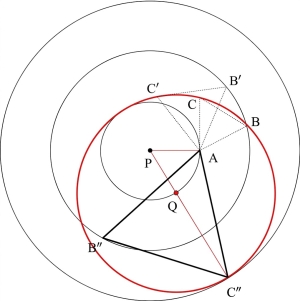
All the points \(C\) trace out a fourth circle, because the transformation taking \(B\) into \(C\) is a rotation by \(+\frac{\pi}{3}\) around point \(A\), and such transformations take circles into circles. The transformation preserves the radius and maps centers also, so the radius of the new circle is also \(2\) and its center is obtained by rotating \(P\) around \(A\) by \(+\frac{\pi}{3}\). This is point \(Q\) in the diagram, \(60°\) south of east from \(P\) and \(1\) unit from it, on the inner circle.
This circle intersects the outer circle in one point \(C''\), and \(\triangle AB''C''\) solves the problem, where \(B''\) is the point on the middle circle mapping to \(C''\).
The Law of Cosines produces the length \(AC''\) when applied to \(\triangle PAC''\), since \(PA = 1, PC'' = 3\), and the angle between them is \(60°\):
\begin{align*}
AC''^2 &= PA^2 + PC''^2 - 2(PA)(PC'')\cos{60°}\\
&= 1 + 9 - 2 \times 1 \times 3 \times \tfrac{1}{2}\\
&= 7\\
\therefore AC'' &= \sqrt{7}\tag*{QED.}
\end{align*}
Following is a collection of problems in the same vein. Locate one where you have a shot and give it a try. If not coming, left-click the problem's "hint" link for a pop-up window giving some suggestions. If still a mystery, right-click the "solution" link to show the answer in a separate tab. Look at the picture in the solution for three seconds and then look away and see if the solution is any clearer. If not, study the solution. It is well worth your while to get Dan Pedoe's book Geometry and study it intensively for the magic key to this type of problem, Chapter II (Circles) and Chapter V (Mappings of the Euclidean Plane) in particular, cheap from Dover. [1]
Problem 1: Given three distinct parallel straight lines in the plane, construct an equilateral triangle with a vertex on each line. (hint, solution)
Problem 2: Two circles \(\mathscr{C}_1\) and \(\mathscr{C}_2\) are given, and a line \(\ell\). Construct squares \(ABCD\) with \(A\) and \(C\) on \(\ell\), with \(B\) on \(\mathscr{C}_1\), and \(D\) on \(\mathscr{C}_2\) (Pedoe 1988, Problem 41.2, p. 163). (hint, solution)
Problem 3: Given three concentric circles, construct an equilateral triangle with a vertex on each circle (generalization of the worked problem). (hint, solution)
Problem 4: Given a circle and two straight lines intersecting inside the circle, construct a chord which is bisected by the point of intersection of the two lines. (hint, solution)
Problem 5: Given four distinct parallel lines, construct a square with a vertex on each line. (hint, solution)
Problem 6: Given an acute triangle, construct a square inside the triangle with one edge along a side of the triangle and the two other vertices on the other sides of the triangle. (hint, solution)
Problem 7: Given three distances \(a, b, c\), construct (using straightedge and compass and without analytic geometry) a square \(ABCD\) and a point \(P\) such that \(|PA| = a, \; |PB| = b\), and \(|PC| = c\) (Mathematics Magazine Problem 1418, April 1993). (hint, solution)
Problem 8: \(ACPQ\) and \(BARS\) are squares on the sides \(AC\) and \(BA\) of a triangle \(ABC\). If \(B\) and \(C\) remain fixed, whilst \(A\) varies, prove that the line \(PS\) always passes through a fixed point (Pedoe 1988, Problem 14.3, p. 66). See the animation above! (hint, solution)
Mike Bertrand
Nov 4, 2026
^ 1. Geometry: A Comprehensive Course, by Dan Pedoe, Dover Publications, Inc. (1988), ISBN 0-486-65812-0, originally published in 1970.