Rose Marie Bertrand

 Rose Marie Bertrand with granddaughter Marie
Rose Marie Bertrand with granddaughter Marie
March 20, 1943 — July 9, 2015

MADISON, WI — Rose Marie Leona Wnek Bertrand, age 72, of Madison, Wisconsin, passed away on July 9th, 2015.

Rose Marie was born on the south side of Chicago, to Bernice (Zajac) Wnek Miller and Joseph Wnek on March 20, 1943. Rose Marie attended St. Roman’s grammar school, Our Lady of Good Counsel grammar school and Visitation High School in Chicago and moved to Madison at age 17 to attend Edgewood College. Rose Marie attended UW-Madison for graduate school, where she met the love of her life, Michael Bertrand. Rose Marie and Michael married at St. Paul’s University Catholic Center in Madison on August 29th, 1970.

Hoffmann Comes for Lee Enterprises and the Wisconsin State Journal

 Capital Newspapers on Fish Hatchery Rd.

Lee Enterprises is a large Iowa-based newspaper chain which owns the St. Louis Post-Dispatch, the Omaha World Herald, and many others, including the Wisconsin State Journal in Madison, the second largest newspaper in the state.[1] David Hoffmann bought them on December 30, 2025. The deal involves Hoffman buying $35 million of new Lee stock, so he now owns over 50% of the stock of this publicly owned corporation[2] and becomes (probably at deal signing) the chairman of the board with the ability to approve all other board members. Hoffmann professes an affection for newspapers as boosters of their local communities with coverage of high school football of the kind he apparently experienced as a young quarterback — the hard-hitting investigative role is presumably a thing of the past. He definitely believes newspapers can be turned into profit centers, a function Lee has ingloriously failed at, hence the transition. This is momentous for Lee of course, but also for all the newspapers they own and the communities they serve; what his accession might mean remains to be seen.

Henri Pirenne on the Medieval Economy

 Pirenne cover

The European economy collapsed between 800 AD and 1,000 AD, even the term “dark ages” inadequate to describe the catastrophe. The marauding Northmen, Saracens, and Hungarians brought this about, the massive security threat bringing commerce to a halt and forcing every locale onto the defensive. There was little communication and virtually no trade between communities, each manor a small and, when luck held, self-sustaining economic unit. There was no margin for error and much suffering when a crop failed. Craftsmen like blacksmiths and carpenters worked in manorial workshops to provide essential services like repairing plows.

The clouds started to recede about 1,000 AD, and Henri Pirenne explains the revival in this magisterial work, Economic and Social History of Medieval Europe — see my beat-up old copy on the right ($1.25!). There are 219 pages of text, each one packed with detail and adding to the overall picture.

The Erdös-Ginzburg-Ziv Theorem

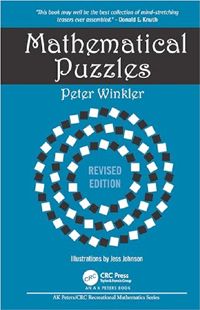
 Mathematical Puzzles cover

I've tried my hand at a few of Peter Winkler's stumpers in Mathematical Puzzles[1] with limited success when I lighted on this innocuous-looking one on page 43:

Even Split. Prove that from every subset of \(2n\) integers, you can choose a subset of size \(n\) whose sum is divisible by \(n\).

Aha! One I understand and can no doubt address with some application. Sometimes you can get an idea of the general solution by working through the problem for small \(n\). \(n=1\) and \(n=2\) are easy and \(n=3\) isn't too bad, but \(n=4\) leads to a rat's nest of special cases. I knew trouble was imminent after trying Gemini ("Prove that from every set of 8 integers, you can always choose a subset of size 4 whose sum is divisible by 4"). Several things jumped out:

• It's possible to feel sorry for Gemini as it engages in some world class wheel-spinning.
• Examining cases for small \(n\) brings zero illumination.
• The problem is well known as the Erdös-Ginzburg-Ziv Theorem (EGZ).[2]

Lee Enterprises — End of the Line?

 Wisconsin State Journal front page — Sep 4, 1952
Below is the deep research report from Google's AI engine Gemini for the question "What is the economic health of Lee Enterprises?", asked on June 25, 2025. I did not change or add a single character. My only changes were increasing the size of the main headline and color-highlighting some sections in red. The image here is the Lee Enterprise Wisconsin State Journal's front page for Sep 4, 1952 and no AI involved with this image, it is straight from microfilm at the Wisconsin Historical Society without alteration. The McCarthy in question was their good friend Joe McCarthy. The image below, however, is courtesy of Gemini.
— Mike Bertrand
June 26, 2025

Ivan Niven's Proof that \(\pi\) is Irrational

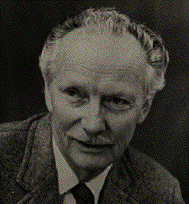
 Ivan Niven
Ivan Niven (1915-1999)

Ivan Niven gave a one page proof that \(\pi\) is irrational in 1946.[1] I had to work a bit to understand it, so thought a write-up was in order. The proof is by contradiction. Niven starts by assuming that \(\pi = a/b\) for positive integers \(a, b\). Then define:
\begin{align*}
f(x) = f_n(x) = \frac{x^n(a-bx)^n}{n!},
\end{align*}
for some positive integer \(n\). I'm generally going to stick to the notation \(f(x)\) in what follows, otherwise things get a bit top-heavy. Just keep in mind that \(f(x)\) depends on \(n\).

Liouville's Inequality and Liouville Numbers

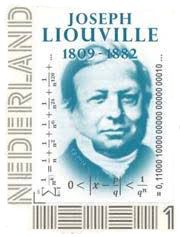
 Liouville Stamp

Liouville was the first to produce transcendental numbers.[1] These "Liouville numbers" are of the form:
\begin{align*}
\frac{1}{a} + \frac{1}{a^{2!}} + \frac{1}{a^{3!}} + \frac{1}{a^{4!}} + \cdots,
\end{align*}
where \(a\) is a positive integer. The key is Liouville's inequality:[2]

For every real irrational algebraic real number \(\alpha\) of degree \(n\), there exists a positive number \(C\) such that for arbitrary integers \(p\) and \( q \; (q > 0) \):
\begin{align*}
\left|\alpha - \frac{p}{q}\right| > \frac{C}{q^n}.\tag{1}
\end{align*}

Lebesgue's Proof of the Weierstrass Approximation Theorem

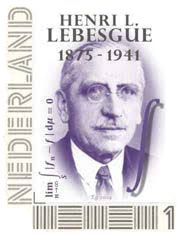
 Lebesgue Stamp

The Weierstrass Approximation Theorem states that a real continuous function on an interval can be uniformly approximated as close as desired by polynomials. That is, given a continuous real function \(f: [a,b] \rightarrow \mathbb{R}\) and an \(\varepsilon > 0\), there is a polynomial \(p(x)\) such that \(|f(x)-p(x)| < \varepsilon\) for all \(x \in [a,b]\). Weierstrass first proved this theorem in a fruitful but unintuitive way in 1885.[1] Lebesgue's proof of 1898, presented here, takes a natural approach that Euclid would have appreciated.[2] Weierstrass proved the theorem towards the end of his career when he was 70 years old; Lebesgue's proof was in his first published paper at the age of 23. Lebesgue stitches together three principles:

1) A continuous function on an interval can be uniformly approximated by a polygonal line.

2) A polygonal line can be represented as a constant plus a sum of functions of the form \(a|x-b|\).

3) The function \(|x|\) can be uniformly approximated by polynomials on an interval.

The USSR Olympiad Problem Book

 USSR Problem Book

I'm working through the problems in this book in a (vain) attempt to prove I'm as smart as a good Soviet high school student in 1935. The complete title is The USSR Olympiad Problem Book: Selected Problems and Theorems of Elementary Mathematics, first published in English in 1962 and available in a cheap Dover reprint or at archive.org.[1] The problems are unconventional with a pedigree going back to the 1930s and are targeted at advanced high school students — they require little to no advanced machinery, but a great deal of ingenuity to solve in most cases. I wrote up about half of them up to #106 and then skipped ahead in order to have one for each chapter to show below, always trying hard to solve a problem, maybe over days, before peeking at the hint in the back or the solution when severely pressed. The questions take up the first 73 page of the book, the solutions the last 349 pages. Sometimes a problem is just plain out of reach, even after some effort, in other cases unappetizing for some reason — only then is a look at the solution in order.

Tatuzawa and Iseki Prove Selberg's Inequality

 Atle Selberg
Atle Selberg (1917-2007)

In 1949, Selberg and Erdős proved the Prime Number Theorem in an elementary way based on an inequality Selberg had proved shortly before, "elementary" meaning without the machinery of complex analysis.[1] This was notable because the theorem had first been proven by Hadamard and de la Vallée Poussin in 1896 using complex analysis and there had been doubts that an elementary proof was possible. The Prime Number Theorem states that:
\[\lim_{x \to \infty} \; \frac{\pi(x)}{x/\log{x}} = 1, \hspace{8pt} \text{ where } \pi(x) = \text{ #primes } \leq x.\]
It seemed unreasonable that such advanced methods far from basic number theory were necessary to prove a theorem about prime numbers. Selberg closed the gap in 1949 and Tatuzawa and Iseki[1'] gave a compact proof of Selberg's Inequality in 1951, a derivation I propose to follow in this article.[2]

Pages

Subscribe to Ex Libris RSS