I still remember the day in seventh grade when, alone in the classroom, I found the geometry problems section in the appendix of one of our books and started to work them out, tentatively at first, but increasingly confidently as they started falling into place. Joyfully too -- bitten by the bug and still infected after all these years. The problem notebooks become buried under files with more pressing business, always to be brought back to the top after a time to receive another solution.
The preoccupation can become an ongoing part of your psyche. Ramanujan used to say that a Hindu goddess came to him in dreams with his formulas and he would write them down first thing in the morning. Poincaré has a story (as I remember it) that he had hit a stone wall on a problem after considerable application. He decided he needed a break and took a trip to the country by bus. When disembarking, as his foot rose from the last step and before it fell on the ground, the solution came to him. I was waiting for a friend at a bar once and drew a diagram of a geometry problem I'd been working on unsuccessfully on a napkin, not even applying myself, just doodling absent-mindedly, when the solution revealed itself.



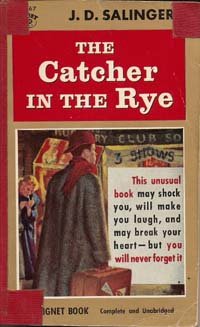 So says the front of my copy of The Catcher in the Rye (24th printing of the Signet paperback, December 1962), a wrenching picture of Holden in flight on the cover. J. D. Salinger, Rest in Peace, dead at 91 on January 27, 2010. Like my friend Dan says, a moment of note for boys of a certain age.
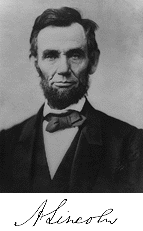 Fondly do we hope -- fervently do we pray -- that this mighty scourge of war may speedily pass away. Yet, if God wills that it continue, until all the wealth piled by the bond-man's [slave's] two hundred and fifty years of unrequited toil shall be sunk, and until every drop of blood drawn with the lash, shall be paid by another drawn with the sword, as was said three thousand years ago, so still it must be said "the judgements of the Lord, are true and righteous altogether."