
Hoffmann Comes for Lee Enterprises and the Wisconsin State Journal

Lee Enterprises is a large Iowa-based newspaper chain which owns the St. Louis Post-Dispatch, the Omaha World Herald, and many others, including the Wisconsin State Journal in Madison, the second largest newspaper in the state.[1] David Hoffmann bought them on December 30, 2025. The deal involves Hoffman buying $35 million of new Lee stock, so he now owns over 50% of the stock of this publicly owned corporation[2] and becomes (probably at deal signing) the chairman of the board with the ability to approve all other board members. Hoffmann professes an affection for newspapers as boosters of their local communities with coverage of high school football of the kind he apparently experienced as a young quarterback — the hard-hitting investigative role is presumably a thing of the past. He definitely believes newspapers can be turned into profit centers, a function Lee has ingloriously failed at, hence the transition. This is momentous for Lee of course, but also for all the newspapers they own and the communities they serve; what his accession might mean remains to be seen.
The State Journal has a storied history in Madison going back to 1839 — they endorsed William Henry Harrison for president in 1840. They were early abolitionists and continued as progressive stalwarts into the early twentieth century, but parted from progressive champion Fighting Bob LaFollette and began a long march to reaction, including sustained, rabid support for Wisconsin native son Joe McCarthy. Lee bought the State Journal in 1919. The paper has moderated in recent years but continues to be seen as an interloper out of step with the community.
Lee has been failing as a business for years, the rate accelerating in 2025. Operating profits could not cover their massive debt service. They claimed to be executing a "digital strategy" to replace declining print subscribers with online ones, but the rate of conversion is low, digital subscribers are less lucrative than print subscribers, and Lee's digital sophistication seems to be lacking. These developments have been closely watched by people like Hoffmann, who has been stalking Lee since at least August 2024.
Accelerating Failure
Print newspapers have been struggling for some time and many to this day seem not to understand what hit them. The business model is to sell subscribers to advertisers, but the ancient hope is for a newspaper to be so much more than that. The ongoing formation of public opinion and outlets for its expression, the hallowed mission of speaking truth to power and exposing injustice, of providing an independent check on public and private power by the very act of exposure — these critical functions are why the press was singled out in the First Amendment:
Congress shall make no law respecting an establishment of religion, or prohibiting the free exercise thereof; or abridging the freedom of speech, or of the press; or the right of the people peaceably to assemble, and to petition the Government for a redress of grievances.
The chronic danger is that the press can become a power center in its own right, one with special legal privileges and monopoly power, fully capable of abandoning the mission, of abusing the trust placed in it. The Wisconsin State Journal is a case study of an organization which, together with its owner Lee Enterprises, has long since abandoned these lofty principles.
According to Lee's SEC 10-K reports, the State Journal reached its greatest print circulation around the year 2000 (peak Sunday in 1998 at 159,827, peak weekday in 2004 at 92,558). It's been downhill ever since — in their 2025 10-K, Lee reported 47,600 "Digital & Print Subscribers" as of September 2025, a highly suspicious number.[3] Accurate circulation figures are of course the key to setting advertising rates and in days past, the Audit Bureau of Circulation oversaw and periodically audited print circulation numbers, but there seems to be little or no oversight of reported digital subscription numbers today. Hoffman has been skeptical of Lee's digital numbers and indeed all their performance metrics. In his open letter to Lee's board of October 13, 2025, he called for them to:
• Regularly disclose key performance metrics (beyond headline-creating cost cuts), including transparent digital subscriber growth, content engagement trends, retention, newsroom headcounts, and local advertising pipeline.
• Incorporate credible third-party audits of performance, resource deployment, and risk management (including cybersecurity, privacy, and legal risk).
Lee's financials in recent years have been disastrous, data below from their 10-Ks:
| 2022 | 2023 | 2024 | 2025 | |
|---|---|---|---|---|
| Print Revenue | 541 | 418 | 312 | 264 |
| Digital Revenue | 240 | 273 | 299 | 298 |
| Operating Revenue | 781 | 691 | 611 | 562 |
| Operating Expenses | 762 | 660 | 611 | 571 |
| Operating Profit | 19 | 31 | 0 | (9) |
| Debt Service | 42 | 41 | 41 | 41 |
| Net Income (Loss) | 97 | (3) | (23) | (36) |
The first two rows add up to the third one and the fifth row is the difference of the two rows above it. Incidentals not included result in the last three rows not quite reconciling, but a number of things jump out from the abbreviated balance sheets:
• Print revenue is cratering.
• Digital revenue is increasing slowly or leveling off.
• Operating profit is low to non-existent.
• Debt service swamps any small profit, leading to increasing net losses over the years.
It's comical hearing Lee flacks explain the success of their digital transformation because digital revenues now exceed print revenues, whereas the improving ratio is mostly due to the collapse of the latter rather than the rise of the former. The crushing debt of $455 million was at 9% interest and the principal has not been reduced in years — in fact it increased earlier this year when the lender waived some monthly payments when Lee became near terminal insolvency (Hoffmann's deal included a reduction of the rate to 5% for five years). Lee could not get out from under this debt, which dwarved their market cap. Apparently there wasn't a commercial banker in the country who would give them a better rate.
Abdicating Journalism
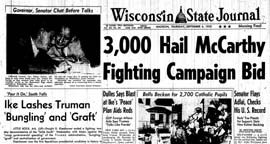
State Journal front page — Sep 4, 1952.
The State Journal has not been a good match for Madison for a long time; they graduated from being a revolting far-right rag to a center-right vehicle as Madison and Dane County have moved inexorably to the left. In the pivotal election for Wisconsin Supreme Court on April 1, 2025, for example, Dane County went for the progressive candidate Susan Crawford by 81.7% — 18.3%, providing a margin of 181,757 votes in an election she won by 238,807 votes (this was the election Elon Musk tried to throw by donating $27 million to the Republican-aligned candidate). She got over 97% in some inner-city wards in this high turnout election. The State Journal endorsed her, as they sometimes will when the balance of forces becomes this overwhelming.
I remember one article in the State Journal where the journalist mercilessly mocked the newsletter of the Willy Street Co-op and the reader comments section in particular — what a bunch of ridiculous left-wing hippies! This co-op has been much beloved and massively successful in the community; one of their contributions has been to plant a new store on the northeast side in a food desert. It seemed tone deaf and I reached out to the journalist, who responded graciously and said she loved the co-op. No doubt some of those comments were silly, but why would an editor in Madison, Wisconsin take up valuable column inches to brutally ridicule these inoffensive folk in their home-town newspaper? Kissing up and kicking down, that's the Wisconsin State Journal. They've been ignorant of Wisconsin traditions (including their own) and insensitive to developing trends in the community to the extent that the out-of-town puppeteering has been patent. Here are two case studies from years past, and it would have been a full time job recounting such missteps as they occurred.
In-house news generation is mostly a thing of the past at the State Journal. Recent spot checks on a Friday and Wednesday showed the paper to have two sixteen page sections with most content from syndicators including mainly the AP, but also USA Today, the Pittsburgh Post-Gazette, the Chicago Tribune, and various Lee outlets. Even a consequential national story with local implications that the paper is uniquely qualified to address was farmed out to the St. Louis Post Dispatch (namely, Hoffmann's buying Lee — see page A4 of the print edition on December 31, 2025). Why anyone would pay $3.00 for this sad excuse for a newspaper is beyond me (what it cost at the drug store). Let's see, $3.00 five times weekly plus $5.00 for Sunday, that comes to $1,040.00 per year. Maybe it's less for delivery, but hard to say what any subscription costs with Lee.
Strip Mining the Assets
Chronic complaints have been directed at Lee papers about their billing practices. A common theme becomes clear when examining the Lee pages at the The Better Business Bureau — customers write of being lured in by a cheap subscription (only $1 for a month!), then being unable to quit no matter what they do. The cancellation button is inactive, you're kept on the phone interminably, and so on. This report from WKBW-TV in Buffalo on Mar 12, 2025 reveals issues consumers have had with Lee's paper there, starting:
Many long-time Buffalo News subscribers are frustrated with the paper's owner, Lee Enterprises. They said the company doesn't help them cancel a subscription or give them answers to questions they have.
View the video if you need your blood pressure to spike. An 88-year-old woman on oxygen who has subscribed for nearly fifty years had her subscription increased automatically from $26 to $169 and could not get redress from the company no matter what she did, and there were many others with similar issues. It looks a lot like preying on your most loyal and vulnerable subscribers. The gritty consumer protection practiced here by WKBW-TV is exactly what Lee newspapers have forsaken as businesses and as journalistic enterprises. The Wisconsin Bureau of Consumer Protection took action against Lee in 2020 and secured an agreement to redress allegations of deceptive billing practices. There seems to be a common thread. The effect is to buoy up the count of digital subscribers, a vital metric for Lee's "transition to digital", their supposed lifeline to the future, but at great cost in good will and damaged reputation.
Hoffman is hard on the moguls running Lee, writing that:
We are most concerned that the current trajectory appears to disproportionately benefit a narrow leadership tier at the expense of long-term value for shareholders, readers, and employees. Excess focus on short-term cost control or financial engineering often sacrifices capability, morale, innovation, and legitimacy.
.
.
.Let us be clear: if Lee continues down its current path of relentless austerity without bold reinvestment and strategic clarity, we fear the Company may degrade beyond rescue while losing subscriber base, advertiser relevance, employee productivity and institutional trust. That outcome would leave even the top leadership with minimal legacy and little value to deliver.
It seems a mild verdict, considering that Lee's stock price has declined from $490.00 on Jun 4, 2004 to $3.73 on Dec 29, 2025 (just before Hoffman's plan was accepted). Note that $490.00 in 2004 dollars translates to about $835.00 in 2025 dollars. Just in 2025 the stock price declined from $14.28 (Jan 2) to $3.73 (Dec 29).
What It Might Mean for Madison
That is the question of the hour, at least for Madisonians. The first unknown is whether Hoffmann will retain the State Journal. Their brand is shot, their circulation anemic, but they are at the center of a complex of smaller Lee papers throughout southern Wisconsin that might have some value. Also, there is their shopper Badgerland Values, mailed to every household in the vicinity whether you want it or not. I wouldn't be a bit surprised to see him dump the State Journal and retain Badgerland Values, adding things like high school sports and lifestyle features to the shopper. There is the plant on Fish Hatchery Road, it's hard to see this real estate man wanting to keep such a dinosaur that could presumably be turned into hard cash for the land.
Lee Enterprises, the Wisconsin State Journal, and The Capital Times are joined at the hip. According to Lee's 2025 10K:
We (Lee) have a 50% ownership interest in MNI (Madison Newspapers, Inc.), which publishes daily and Sunday newspapers, and other publications in Madison, Wisconsin, and other Wisconsin locations, and related digital sites. Net income or loss of MNI (after income taxes) is allocated equally to us and The Capital Times Company (“TCT”). MNI conducts its business under the trade name Capital Newspapers.
Hoffman and the luminaries at The Capital Times Company (apparently owned mostly by the Evjue Charitable Trust and the Evjue Family Trust) will have to agree on the next step. In principle, the current arrangement could continue, but that seems unlikely considering how much of the MNI profit goes to TCT. If my calculations are correct, only a small portion of the TCT cut goes to operations at the Capital Times, the rest to the Evjue trusts.
In the end, none of this might matter much for the media landscape in Madison, except as a final wake-up call that the old order is gone for good. David Hoffmann goes on about his nostalgia for newspapers, but his organs barely qualify for that designation as understood in the past (check out his Florida Weekly to get the idea). Yes, they are printed but they have little to do with probing news, analysis, and opinion that has animated those who've valued the Fourth Estate for centuries.
The media system in Madison is burgeoning, even the venerable Cap Times has been showing signs of life. Then there are the new and rising players, non-profits and businesses alike bidding to expand their reach, including the Wisconsin Examiner, Wisconsin Watch, Civic Media, Isthmus, and Channel 3000. The shake-up has been building up steam in recent years — the day of reckoning has finally arrived.
Mike Bertrand
January 4, 2026
Update (Jan 18, 2026): Definitive circulation figures are found in the State Journal's Form 3526, filed with the USPS, which appeared in the paper on Sep 12, 2025 on page A4. On Sunday Jun 1, 2025, the State Journal sold 18,728 printed copies. Their average paid distribution of printed copies for the preceding 12 months was 16,664. Paid electronic copies on Jun 1, 2025 numbered 19,790, compared to an average of 22,711 for the preceding 12 months. So much for the transition to digital.
^ 1. More accurately, Lee owns 50% of MNI (Madison Newspapers, Inc.), which publishes the Wisconsin State Journal. The Capital Times Company owns the other 50%. "Lee owns the Wisconsin State Journal" is a reasonable shorthand though, considering that Lee controls the business and editorial functions of the State Journal.
^ 2. By my calculation, there were 6,261,777 shares on Dec 29, 2025, the day before the deal went through, of which David Hoffmann held about 626,178 (10%). The deal involved selling 15,384,615 shares to new investors for $3.25 each, for $50 million in new investment. Hoffmann contributed $35 million — that is, he bought 10,769,231 shares. The new share total is 21,646,392, of which Hoffman owns 11,395,409, coming to 52.6% ownership.
^ 3. Mixing print and digital subscription numbers obscures each component. David Hoffmann himself has expressed frustration at this obfuscation. At the same place in their 2025 10K, Lee reports an average of 683,000 unique visitors to their site madison.com each month, which means approximately nothing — I'm probably in there each month as I follow stories to their site before being blocked by the paywall. It may (or may not!) be of note that they reported 1,934,000 as the monthly average of unique visitors in 2018. Numbers, but not relevant ones, and all with the effect of obscuring the actual situation. See the update for accurate paid distribution figures and a breakdown between print and digital.