
Henri Pirenne on the Medieval Economy
The European economy collapsed between 800 AD and 1,000 AD, even the term “dark ages” inadequate to describe the catastrophe. The marauding Northmen, Saracens, and Hungarians brought this about, the massive security threat bringing commerce to a halt and forcing every locale onto the defensive. There was little communication and virtually no trade between communities, each manor a small and, when luck held, self-sustaining economic unit. There was no margin for error and much suffering when a crop failed. Craftsmen like blacksmiths and carpenters worked in manorial workshops to provide essential services like repairing plows.
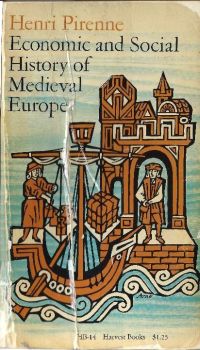
The clouds started to recede about 1,000 AD, and Henri Pirenne explains the revival in this magisterial work, Economic and Social History of Medieval Europe — see my beat-up old copy on the right ($1.25!). There are 219 pages of text, each one packed with detail and adding to the overall picture.
It is beyond understanding and profoundly humbling to read in the front that this is but a small piece of a larger project:
(This book) first appeared in 1933 in volume 8 by Henri Pirenne, Gustave Cohen, and Henri Focillon of “Histoire du Moyen Age”.
This exact paperback edition is still available cheaply online and is at Google Books. Page references below are to this edition. Other editions are available as well.
Collapse
In the short introduction, Pirenne explains how the Roman empire's successor kingdoms in the West, established in the fifth century, continued a robust trade centered on the Mediterranean Sea. In this respect they were true successors, carrying on long-established practices of the empire. He recounts the catastrophic effect of the Islamic incursions into the Mediterranean, which became increasingly bold and threatening as the seventh century progressed, to the point where the 14th century Islamic historian Ibn Khaldun is reputed to have written that the Christians "can no longer float a plank on it (the Mediterranean)". (pp. 2-3) The Arabs held most of Spain by 711, all of north Africa from early on, and dominated the Tyrrhenian Sea. This went on for centuries, with Sicily, Corsica, and other outposts falling to them in time (they pillaged Pisa in 935 and 1004).
What Islam did in the Mediterranean, the Northmen did in the north and the Hungarians did in the east. Europe reverted to a fragmented fortress, even kings retaining little power as the feudal system based on local agriculture transferred power to local elites, sometimes super-local ones based on a single manor. Most of Europe reverted to a purely agricultural state as inland commerce disintegrated:
In fact, the appearance of feudalism in Western Europe in the course of the ninth century was nothing but the repercussion in the political sphere of the return of society to a purely rural civilization. (p. 8)
The Church played a dominant moral and indeed economic role in this society, fortified by accumulated alms and bequests from believers. Churchmen were the last to be literate and courts depended on them for the most basic functions of record-keeping, accounting, and correspondence. "The Church's conception of the world was admirably adapted to the economic conditions of an age in which land was the sole foundation of the social order." (p. 13) They condemned receiving interest on loans, calling it usury, and here our commonplace word "condemned" has an entirely more grave and coercive meaning. They held commerce itself and profit of any kind to be disreputable if not sinful. The very notion that people might want to materially improve their lives was alien and at cross purposes with the need for resignation to one's assigned station in life.
The Revival of Commerce
Maritime commerce in the Baltic and North Seas continued to exist, though greatly reduced. In fact the Scandinavian marauders themselves gradually turned to commerce as the generations unfolded. Founded earlier as a refuge, Venice evolved into a Byzantine outpost and by 900 AD was well on the way to becoming the independent maritime powerhouse it was soon to become, diverging sharply from the pattern in continental Europe. Pirenne notes that commerce being contagious and all-pervasive, these two peripheral outposts started to insinuate their influence into the surrounding mainland. Pisa and Genoa engaged in a long and eventually successful campaign to roll back Arab influence in the Tyrrhenian Sea, to the point of sacking Mehdia in Morocco in a massive raid in 1087, a prelude to the first crusade in 1096. Venice, Pisa, and Genoa played major roles in transporting and provisioning the crusader armies, which literally could not have got off the ground without the help of those maritime businessmen, for that is what they were:
Thus the whole Mediterranean was opened, or rather re-opened, to western navigation. As in the time of Rome, communications were established from one end to the other of this essentially European sea. The exploitation of its waters by Islam was at an end. The Christians had recaptured the islands whose possession guaranteed its mastery, Sardinia in 1022, Corsica in 1091, Sicily in 1058-1090. (p. 30)
The mercantile Italian towns gained a foothold in Byzantium, which increasingly depended on them militarily and commercially. This was the lasting legacy of the crusades: to give mastery of the Mediterranean to the Italian towns. This sea-borne commerce served to quicken inland trade, not only in northern Italy, but also in Provence and Catalonia. Pilgrims and merchants breached the Alpine passes in the 11th century, leading to commerce between northern Italy and southern Germany. There is evidence of Italian merchants in northern France by 1050, where they exchanged goods from the Levant with Flemish textiles.
The Scandinavians gradually evolved from piracy to commerce along the North and Baltic seas but also down the rivers, founding their gorods (fortified towns) and indeed the first Russian state. The depth of their penetration is illuminated by a contemporary account by the Byzantine Emperor Constantine Porphyrogenitus:

[Constantine] in the tenth century, has left us with a picture of the Scandinavians, or rather the Russians (to give them the name by which the Slavs knew them), assembling their boats each year at Kiev, after the melting of the ice. The flotilla slowly descended the Dnieper, whose innumerable rapids presented obstacles which had to be got round by towing the barks along the bank. Having reached the sea, it sailed along the coast to Constantinople, the goal of the long and perilous voyage. (p. 22-23)
This began in the ninth century. The Byzantines deeply influenced the Russians — think of the latter's religion, art, and alphabet, but the influence was across the board. The trade was two-way, with spices, wines, silks, and gold artifacts heading north and honey, furs, and slaves heading south. Pirenne compares these Nordic adventurers to the Greeks in the Homeric era, evincing a similar energy and spirit of enterprise: "Their art was characterized by a barbarous originality, which nevertheless betrays the influence of that East with which their commerce brought them into communication." (p. 25)
The acceleration of trade promoted industry in the hinterland adjacent to the ships' reach, particularly Lombardy in northern Italy and Flanders. Textile production in Flanders goes back to Celtic times and revived greatly once high-quality English wool became available and export outlets started to revive about 1,000 AD. Flemish cloths were renowned for quality and circulated broadly throughout Europe and beyond, including to the Levant and Novgorod. "In the course of the twelfth century the whole of Flanders became a country of weavers and fullers." (p. 36) These early vessels were rudimentary, so tended to carry high-value cargo of low or medium weight like textiles and spices. The famous Champagne fairs became in time a great conduit for trade connecting northwestern Europe with Mediterranean entrepôts.
The Towns
Town life persisted much on the old pattern in Italy, Gaul, Spain, and Africa after the fall of Rome. But the rise of Islam and consequent collapse of commerce killed the towns in the Mediterranean basin, except in northern Italy. What Islam did in the south, the Vikings did in the north. Many towns became centers of church administration, but they lost economic significance. As security became paramount, lords sequestered themselves in moated castles and towns erected fortified walls. Vilains constructed and maintained the fortifications, knights and canons resided within, and peasants in the surrounding countryside provided food. These fortified burgs became places of refuge and passage for travelling merchants as trade revived and before long they established permanent commercial houses there, but in a faubourg outside the walls (faubourg = outside the bourgh):
The reason why they (the merchants) became, before the end of the eleventh century, to be known by the word bourgeois, which was really much better suited to the inhabitants of the old burgs, at the foot of which they settled, is to be found in the fact that very early the mercantile group too surrounded itself by a wall or palisade for the sake of security, and thus became a burg in its turn. This extension of meaning is all the more easily comprehensible, since the new burg very soon overshadowed the old. (p. 42)
The faubourghs grew over time to become the cities of today. These early towns soon became magnets for nascent industry, textile production in the towns of Flanders being a notable example. Pirenne speaks of a "real industrial revolution" at this time (p. 43).
This localized, agricultural society spawned a class of déracinés, younger sons and otherwise dispossessed and landless men with few means who often became vagabonds and had to live day-to-day on the margins. They produced the new men who became the bourgeoisie. St. Godric of Finchale in County Durham stands as an exemplar:
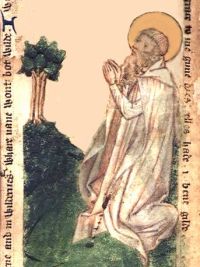
St Godric of Finchale
Godric was born towards the end of the eleventh century in Lincolnshire of poor peasant stock and, forced, no doubt, to leave his parents' holding, he must have had to use all his wits to get a living. Like many other unfortunates in every age he became a beachcomber, on the look-out for wreckage thrown up by the waves. Shipwrecks were numerous and one fine day a lucky chance furnished him with a windfall which enabled him to get together a pedlar's pack. He had amassed a little store of money, when he met with and joined a band of merchants. Their business prospered and he soon made enough profit to enable him to form a partnership with others, in common with whom he loaded a ship and engaged in coastal trade along the shores of England, Scotland, Flanders and Denmark. The partnership prospered. Its operations consisted in taking abroad goods which were known to be scarce there and bringing back a return cargo, which was then exported to places where the demand was greatest and where, in consequence, the largest profits could be realised. (p. 46)
To repeat, the first impetus for this renewal was commercial navigation in the Mediterranean and increasingly in the North and Baltic Seas. Landed capital contributed but was very much a passive partner in this development, which became autonomous and self-driving from early days. The towns became magnets for enterprising people of all sorts, including serfs escaping from their manors to become artisans or workers for the rich merchants in the towns. Trade and industrial concentration proceeded hand-in-hand. A successful apprentice could rise in the service of a wealthy merchant, perhaps marry his daughter, inherit the firm, and further develop the business. So it went, the process building upon itself until great fortunes were amassed in a few generations.
The single most indispensable need of the rising bourgeoisie was personal liberty, the right to move freely and engage in business. This was incompatible with the old order, where the lord commanded his serfs, requisitioned their labor, and could even demand to be their partial heir. Towns became sanctuaries where the lord's men had no authority; they gradually became independent jurisdictions, their communal rights guaranteed by law. Since the existing legal system was completely unable to adjudicate commercial disputes, the merchants themselves established informal systems of arbitration, which before long gained the sanction of official law. These commercial courts have a modern cast, depending on evidence and witnesses like they did. The English courts of piepowder are characteristic.[1] The term derives from pied poudré, dusty foot, presumably the state of those coming before these courts. In short, the towns became "islands of independent jurisdiction". (p. 52)
With legal autonomy came administrative autonomy. Maintenance of the town walls became an abiding concern and communal taxes were levied for this purpose. These taxes were typically based on the ability to pay and had an entirely different character than the confiscatory extortions of feudal lords. In time, municipal taxes went to support the food supply and other infrastructure like bridges and quays required by a business community and indeed the common good. By the late eleventh century, bodies like councils of aldermen in England arose naturally to administer such matters.
The princes tolerated these developments because they generated increased revenues to them. The bishops hated them and they often resided inside the inner walls, leading to conflict and, on occasion, open revolt:
Thus, by fair means or foul, the towns gained peaceably or by force, some at the beginning, others in the course of the twelfth century, municipal constitutions suitable to the life of their inhabitants. Originating in the "new burgs", in the portus, where the merchants and artisans were grouped, they were soon developed to include the population of the "old burgs" and the "cities", whose ancient walls, surrounded on all sides by the new quarters, were falling into ruin like the old law itself. Henceforth, all who resided within the city wall, with the sole exception of the clergy, shared the privileges of the burgesses. (pp. 54-55)
Town people were privileged compared to all who lived outside the walls, they lived in a another world under different laws and with special rights. Like the clergy or nobility, the burgesses had a special status, they constituted the third estate. Each town was its own small state — like ancient Greece, but without the Delian League. And like then, these small polities were jealous of their prerogatives and hostile to all neighbors. It looked more like "sacred egoism" than democracy as presently conceived. (p. 56)
The Land and the Rural Classes
Increasingly important as the Middle Ages progressed, the bourgeoisie was small in number, as was the population of the towns altogether. It must be noted that the picture varied by region, though most locales evolved in similar fashion, if at different times and tempo. The great estate, or manor, dominated rural life — many of them had a continuous existence since Roman times. The manorial lord was akin to a chieftain over his serfs, who were close to slaves. But not the abject slavery of the old American south, since serfs had some rights under this patriarchal system. They typically worked one to three days a week on the lord's land, the rest on their own plots, whose size was just sufficient for subsistence. There were other obligations owed to the lord, like heriot, a sometimes excessive death duty. It was common that the lord's permission was necessary to marry, and that marriage to another serf of the manor was required. Each manor had its church, the incumbent appointed by the lord. Tithing to the church was typically expected and it was not unheard of for the lord to requisition the tithe. The lord's court administered the law of the manor as all more comprehensive jurisdictions withered.
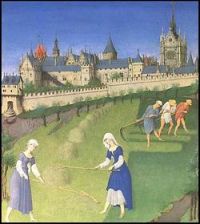
The lords were ecclesiastical as well as secular. Large manors were scattered due to benefices (church) and marriages (lay); they could answer to two or even three different princes and their serfs speak more than one language. These institutions were profoundly local and self-contained, they even had their own workshops to fix a shirt, a wheel, a wine-press. They were deeply static and alien to profit or improvement. They became increasingly at odds with the surrounding society as trade revived:
Nowhere do we see the great landowners taking the first step to bring it (the manor) into harmony with its changed surroundings. ... Clearly it was not they but their tenants who inaugurated the changes, which already in the first half of the twelfth century in the most advanced countries, brought about the decay of the manorial system. (pp. 67-68)
Population increased as the security threat receded and commerce revived, leading to a surplus population and a new class of hôtes — literally guests, more informally new-comers or strangers (pp. 69 ff.). They were vagrants and would-be colonists in search of new lands to cultivate. Princes and manorial lords established ville neuves (new towns) to attract them as free workers rather than serfs (including perhaps some of my ancestors, Villeneuve being a family name). Pirenne compares the ville neuves to popup towns in the American west in the nineteenth century, with similarities "even down to details" — contractors laying out the grid in advance, publicity and inducements to prospective settlers, and so on (p. 70). The Cistercian order, founded in 1098 with the requirement of manual labor for the monks, provided another refuge for the hôtes. Their fine abbeys expanded into previously inarable lands and employed hosts of lay brothers and other workers under a previously unknown rational administration, exploiting and improving the land in ways completely foreign to the manors.
The citizens of the ville neuves were free in a way their parents in the manors were not — they benefited from the new-found rights of town-dwellers, electing mayors and adopting justice systems like they did. Money, never entirely gone, came into more general use. The old nobility was eventually ruined, their workshops gone and the entire economic foundation of their way of life undermined:
It is characteristic that the decay of the seigneurial system advanced in proportion to the development of commerce. In other words, it was much more rapid in the countries with large towns and a great trade like Lombardy, Tuscany, the north of France, Flanders, or the banks of the Rhine, than in central Germany or England. It was only at the end of the thirteenth century that the manorial system began to break down in the latter, while there were already numerous signs of its disintegration in Flanders from the middle of the twelfth century. (p. 82)
But the sway of the past remained powerful and change was glacial, new developments penetrating only slowly to areas of Europe not readily accessible to the trade routes. Even in the more advanced regions, peasants were mostly voiceless and powerless and suffered abuses of power and privilege lasting until the fall of the ancien régime.
Commerce to the End of the Thirteenth Century
Roads were atrocious and brigandage common. Predatory tolls were the norm and there was no thought of using them to improve the roadways. Caravans formed as semi-military troops for protection, the merchants regarding themselves as brothers bound by an oath of loyalty. They would form associations for these expeditions, each participant contributing a portion and profiting correspondingly. Waterways were the "great instruments of exchange and transport." (p. 89) Rivers of course, but coastal shipping even more so, especially when the mariner's compass enabled genuine seafaring in the Mediterranean in the 14th century and in the North Sea in the 15th.
Towns too exacted taxes to use roads, bridges, quays, and so on, but now the proceeds were actually used to finance improvements. As if to make up for the onerous tolls along roads and rivers, there were no political obstacles at the frontier. Princes found ways to prey on commerce, but there was no protectionism until later. Wars of course disrupted commerce and princes would expropriate goods belonging to foreign merchants, but all reverted to normal when peace was restored.
1314 marked the first big expedition of Italian ships to Flanders and others followed. Shipping the other way was slower to develop. Groups of merchants sought legal and practical protections where they ventured, hard to enforce but sometimes granted and indicative of the value being placed on their services:
The feeling of security was growing and the role of brute-force diminishing; and a state of mind was being gradually created which was particularly favorable to the progress of international trade and labour. (p. 93)
The early merchants were vagabonds who traveled with their goods on land and sea. With the advance of experience, learning, and fortune, they tended more to stay at home at the center of their affairs. They employed "factors" at key locations, namely, agents who handled their business there and with whom they corresponded. Vernacular languages came into use in such correspondence, though French or Latin might be used in case of language discrepancy.
Pirenne writes that "the keeping of books (accounting) by merchants seems to have been general, if not obligatory, in the thirteenth century". (p. 123) Double-entry bookkeeping was denoted the "Italian method", because that is where it originated, fostered by a system of merchants' abaco schools already highly developed by Fibonacci's day around 1200. The term abaco referred not to the abacus, but to the art of calculation. These schools trained boys sometimes starting at an early age to be proficient in basic mathematics and Hindu-Arabic numerals, including the attendant algorithms of the kind we learn in grade school today to (for example) add, subtract, multiply, and divide whole numbers. Fractions too of course. Organized to serve the needs of commerce, these schools were typically administered in their mature form by the towns.
There is extended discussion of the medieval fairs in keeping with their pivotal economic role, the Champagne fairs in particular (there were a number of them throughout the county):
One of the most striking features of the economic organization of the Middle Ages was the important role played by the fairs, more especially down to the end of the thirteenth century. (p. 96)
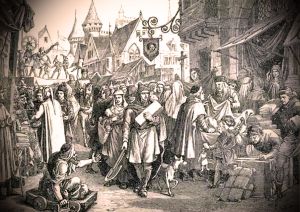
Une foire en Champagne au XIIIe siècle (A fair in Champagne in the 13th century)
Champagne was prominent, but the fairs appeared throughout Europe at the time when merchants traveled far and wide in person to transact business. And so they did at some scale, wholesale trade being prominent. Everything was exchanged, everyone was welcome. Violence of any kind was prohibited, marshals being appointed to keep the "peace of the fair". There was often a kind of sanctuary on the fairgrounds where writs against individuals could not be enforced. These fairs took a great deal of preparation and could last for weeks.
The Champagne fairs of the twelfth and thirteenth centuries were exceptional in attracting merchants from all over Europe. Even the laws against usury were suspended. The Counts of Champagne sponsored their fairs and Champagne was perfectly positioned at the crossroads of European commerce. Flemish cloth vended at Champagne, for example, might be transported to Genoa and then on to the Levant, with spices and silver and gold goods coming the other way. The influence of these fairs radiated throughout Europe. They gave rise to rudimentary financial clearing houses, where debts contracted elsewhere were to be be paid at the fair. Such financial arrangements came to have a life of their own, the fairs becoming virtual money markets as well as bazaars. These extraordinary assemblies peaked between 1250 and 1300, but had a lasting influence:
The practices learned there now opened the way to an economic life, in which the general use of correspondence and the operations of credit enabled the business world to give up its journeys to Champagne. (p. 102)
Money and Credit
Any economic account must consider the role of money, both as a measure of value and a means of exchange. Coins, common during Roman times and in the successor regimes as well, virtually disappeared throughout Europe early in the depressed period. In 793, Charlemagne established a new monetary system well adapted to his agricultural society — a durable one too, with echoes in the present day. In this system, one pound was broken into 240 denarii (compare to the British pound of today where a pound equals 240 pence). The silver half-denarius was the only coin in circulation, and it suited a society engaging exclusively in small retail exchange. The imperial authorities retained the sole right to mint coins, a system that dissolved as the empire itself did.
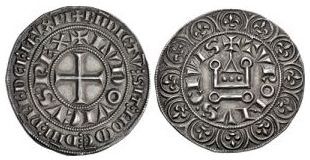
Louis IX's gros tournois — 1266 ff
Feudal princes seized the right to mint coins; as with infrastructure, most of them took a predatory approach having entirely to do with their own parochial interests. It was the norm for centuries for princes to recall coins and melt them down in order to extract silver, only some of which was used for the new debased coinage. When they regained their prerogatives, the kings were generally no better than their vassals had been in this regard, England being an exception. It didn't matter much at first, but the unreliable money supply became a drag on commerce as its tempo increased. Venetians were the first to deliver desperately needed reform in 1192 with the minting of the immensely successful silver groat valued at 12 of the old denarii. Others followed, including in the north. But it was France who hit the jackpot (!), when Louis IX introduced the silver gros tournois in 1266, also worth 12 denarii. This coin rapidly spread throughout the north, aided by the Champagne fairs and the appeal of French civilization generally. Other jurisdictions issued their own gros tournois; the English sterling coins were also successful and much copied.
Florence finally reintroduced gold coins into Europe in 1252 with her florin — the fiorino d'oro, so called because they bore a prominent lily, the emblem of the town (fiorino = little flower). According to Wikipedia, these florins were minted until 1533 "with no significant change in its design or metal content standard during that time". Others followed, including Genoa and Venice, who issued a replica gold florin in 1284, the zechin. Northern Europe followed Italy in coinage, as in all things commercial. Gold coins were minted throughout the continent in the fourteenth century — in Spain, Bohemia, England, Flanders, and elsewhere.
The church had accumulated resources and they were lenders (and just about the only ones) in the darkest period. Loans then were sought only in the direst emergencies, like local famines — in short, they were consumption loans. In this respect the ban on usury was a mercy: mutuum date nihil inde sperantes (Luke 6:35): give without expecting anything in return. Such a system was deeply incompatible with commerce even on the small scale staring to emerge, where merchants might acquire a stock of raw wool in England (for example) and have to defer payment until they could unload it to weavers on the continent. Even in the tenth century the Venetians depended on credit in their pooled maritime investments. Their financial innovations spread quickly throughout northern Italy and more gradually north of the Alps. In the early days of capitalism "banking was never totally divorced from trade in merchandise, upon which it was, so to speak, grafted". (p. 125) The medieval banker was a merchant as well as a borrower and lender.
The great nobles often depended on loans from the town bourgeoisie, who had little choice but to lend to them considering the power discrepancy. Defaults were common, interest rates high, generally 10%-16%. There were no bones about interest in private documents, but the reality might be cloaked in semi-public arrangements, like loans involving towns. Amusing workarounds were at hand, like stipulating a penalty in case of late payment, which somehow always occurred. Another expedient was to require that the amount to be repaid was to be greater than the amount received (don't call it interest though!). The Church's ban on usury could not be completely ignored, however, and remained a background menace throughout the medieval period. Many a successful businessman bequeathed large sums to the Church in hopes of redemption at the pearly gates. A Church whose bankers almost certainly charged interest on the piles of cash they collected, by the way. (p. 138-139) Still:
Altogether the legislation against usury does not seem to have prevented it in practice very much more than the Volstead Act in America prevented the consumption of alcohol. (p. 138)
The Italians were greatly ahead in instituting banking and financing throughout Europe. By 1300 they had established financial houses in the north and held a virtual monopoly in sophisticated banking practices there. They were adept in clearing house transactions, for example, and capable of making large loans in cooperation with other far-away bankers if necessary. They pioneered practices persisting to this day. The kings of England and France depended on this network as did the pope, who presided over huge resources. The Italians completely replaced the Jews in this business, not that the latter's footprint had ever been large (contrary to anti-Semitic slanders):
Compared with the efflorescence and ubiquity of Italian credit, that of the Jews appears a very small affair and the part which they played in the Middle Ages has certainly been much exaggerated. (p. 131)
That did not stop the disgraceful run of pogroms down the ages, sometimes ordered by kings or fomented by jealous rivals and certainly incited by the crusades. In earlier days, Jewish peddlers had been a link to the Levant and the gold or silver goods to be had there. Even that modest role became superfluous with the opening of commerce between Europe and the East. They were edged out as pawnbrokers as well. The high level shakedown artists were all Christians, with interest rates of 40% or more.
Low risk investments became available in the towns in the course of time, notably "life rents" and mortgages guaranteed by real property. Like a lifetime annuity today, a life rent involved the lender handing over a lump sum in exchange for an income stream until the time of death — they were widely used to finance town governments and sometimes subscribed to far and wide as desirable investment vehicles.
International Trade to the End of the Thirteenth Century
Medieval commerce sprang from long-distance trade from the beginning. Spices in particular, but also fine textiles and gold and silver goods were in great demand in the west. Initially the Italians sent back timber and arms and Venice "at least for a certain time", slaves (p. 144). That last word is disquieting, and maybe it's time to note a vast backdrop of bad behavior accompanying the civilizing trend emphasized to this point. The German settlers colonizing the Slav lands routinely resorted to slaughter, as did the Crusaders in the Levant and armed bands and armies operating exclusively in Europe. Economic total war was the norm in protracted conflicts, which could have economic as well as dynastic dimensions:

Le secret des grandes fortunes sans cause apparente est un crime oublié parce qu il a été proprement fait.
The secret of great fortunes without apparent cause is a crime forgotten because it was done without a trace.
— Honoré de Balzac (Le Père Goriot)
The revival of commerce was strictly due to export trade. Strange to say, Pirenne says, but familiar to a reader in 2025 evenly vaguely aware of the rise of the Asian Tigers after 1945, and especially China after 1978. In all these cases, the economy was founded on an export regime, which in turn brought forth a manufacturing sector to supply those pipelines. The importance of the early spice trade cannot be overstated as the foundation for great fortunes in Venice and the other Italian towns — such a compact, valuable commodity perfectly matched the limited capacity of early long-distance transport, either by caravan or ship. The relative importance of spices among Europe-bound goods decreased over the years, but not the insatiable demand for them in the west throughout the Middle Ages and early modern period, continuing after Portugal showed the way to the Orient by ship (the Spice Islands!). What are today ordinary spices like pepper, cinnamon, cloves, and nutmeg were then much-prized in a Europe starved for culinary variety; a cargo of spice arriving at a European port never found demand lacking and profits were commensurate for the adventurous merchants braving shipwreck, piracy, and war. The profits were immense, the imports varied:
From the beginning of the thirteenth century, imports into Europe consisted of rice, oranges, apricots, figs, raisins, perfumes, medicaments, and dyestuffs, such as Brazil wood (which came from India), cochineal or alum. To these were added cotton, which the Venetians called by its Greek name bombacinus and the Genoese by its Arabic name cotone, which they handed down to all languages. (p. 143)
There were damasks from Damascus, baldachins from Baghdad, muslins from Mosul, and gauzes from Gaza. Arabic lent many words to European languages from this time, indicative of the material and cultural penetration, including, in English, divan, bazaar, artichoke, spinach, tarragon, orange, alcove, arsenal, jar, magazine, syrup, taffeta, tare, and tariff. (p. 143) Before long woolen goods became the main export from Italy to the Levant, then after 1250 or so, French and Flemish textiles, which became highly desirable luxury goods outside as well as within Europe. Brabant and Flanders became the foremost centers of textile production for export, including the Flemish towns of Ghent, Ypres, Lille, and Douai.
By virtue of their financial power, Italian firms monopolized the export of Flemish cloth to the south. Large quantities went to Florence, where the Arte di Calimala, the guild of the finishers and merchants of foreign cloth, prepared textiles for further transshipment. Bruges became the Venice of the north, but even that designation understates her role as an international entrepôt intimately connected to international finance as well as trade and connecting them to a deep industrial hinterland. Merchants north and south had establishments there, bankers the same. In short, Bruges became the great meeting place for international merchants, much as the Champagne fairs had been in the preceding period, but now in a regularized and permanent fashion.
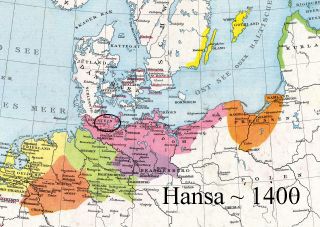
A mighty new force arose in the late twelfth century, the Hanseatic League. The term "hanse" originally denoted a traveling band of merchants, as mentioned above, but eventually came to stand for any society of merchants. Brought together by Lübeck, a newly Germanized town on the Baltic Sea (circled in the image), the Hanse or Hansa as it was called, soon rivaled the Italian ports in volume of trade though not value. It too served as a conduit to eastern lands, though for the Hanse that meant the undeveloped borderlands to their east rather than the Levant. The confederation grew in extent and power over the generations, including Wisby by 1160 — on the big yellow island to the east of Sweden on the map — and before long Rostock, Dantzig, and Riga. Merchants became the cutting edge of the German imperialism of the day, establishing themselves in Lithuanian, Latvian, and Slavic lands to complement the ethnic cleansing of the Teutonic knights.
The Hanse had outposts far and wide, including in London and Novgorod, but above all the kontor at Bruges. Their tentacles spread throughout the hinterland of Poland and Germany and via river to the outskirts of the Balkans. Hanse exports tended towards wheat, furs, honey, timber, tar, and dried fish. They transshipped English wool, Spanish salt, and French wines, and of course Flemish textiles. Bruges was their hub. "No other region in Germany attained the same degree of economic vitality as the Hanse" (p. 149), even as they lagged behind the Italians in financial sophistication.
England was an agricultural backwater until about 1350, her saving grace being unified government. The Hanse carried most exported English wool by the thirteenth century, her later mastery of the waves being slow to develop. "The Cistercian monasteries of England became pre-eminent as sheep farmers" (p. 151) — contrast their efficiency and humility with the corruption of Henry VIII, who expropriated them in the sixteenth century.
France was a more fragmented society. Paris became something of a financial center for Italian firms and was buoyed by the presence of the increasingly influential court, but engaged mostly in local small scale industry, as if it were a large manor in the year 920.
But the role which Paris played in the economic history of the Middle Ages bore no relation to the prestige of French civilization and to the political supremacy of France at the beginning of the reign of Philip-Augustus (pp. 152-153)
Note that Philip-Augustus (Philip II) was king of France from 1180 to 1223. The University of Paris, founded in 1150, contributed to French renown and to her intellectual reach. Her artists and architects were legendary and much sought after throughout Europe. French wines were much appreciated and circulated widely, particularly from Bordeaux — they were called "wines of La Rochelle", because that is where they were shipped from. Hanse ships dominated this trade from about 1350. The movement of French wines to England was considerable and many an English fortune was founded on this trade.[2] By happy coincidence, the salt mines of Bourgneuf were near La Rochelle, so salt also flowed through the port, ships being known to carry wine and salt at the same time.
Pages 160-166 have a nice reprise under the subtitle "The Capitalistic Character of International Trade", including this gem:
As has already been shown, these capitalists, for the most part, sprang from the dregs of society, déracinés, who as soon as trade revived took to it with no assets but their energy and intelligence, their love of adventure and no doubt also their lack of scruples. (p. 162)
They bought cheap and sold dear, with few qualms about demanding exorbitant prices during famine times. Large fortunes were amassed rapidly and, once established, these nouveaux riches were quick to close ranks against the hoi polloi, one hanse barring "those who have blue nails", namely, workers in the cloth industry. (p. 165).
Conclusion
I'm going to wind this down, with only brief summaries of the last two chapters. Chapter VI takes up the urban economy, a critical topic considering that almost all industry took place in the towns and they had an outside influence in the medieval economy. The burgesses dominated the towns, which tended to be self-governing — not modern democracy, but closer to it than the feudal society from which it sprang. The craft guilds grew in power and influence, sometimes virtually running towns. They were deeply parochial and protectionist organizations. An urban proletariat arose as well, leading to nascent class struggle.
Chapter VII concerns the economic changes of the fourteenth and fifteenth centuries. By 1300 or so, the European economy had plateaued and the following period was one of consolidating the massive changes. A series of disasters, culminating in the Black Death of 1347-1350, confirmed the arrest. The Hundred Years' War (1337-1453) was a nightmare for France and bad for England, no matter the final resolution. Social unrest spread in the fourteenth century partly borne of these disasters, but also of a new and as yet unsettled consciousness that a new world was aborning — Pirenne even speaks of "vague communistic aspirations" in some social movements of the day. (p. 197) There were many bloody class struggles. Social stratification intensified in the towns — haute bourgeoisie, master craftsmen, apprentices, day laborers.
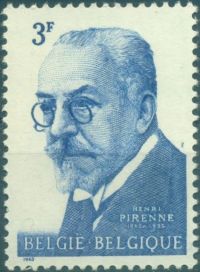
I. E. Clegg translated this book into English, and good English at that; I'm guessing the original French is as good or better.[3] Let the master have the final word:
Au cours du XIIIe siècle, toute l'Europe, de la Méditerranée à la Baltique et de l'Atlantique à la Russie, est ouverte au grand commerce. De ses deux foyers principaux, les Pays-Bas au nord et l'Italie au sud, il a gagné les côtes maritimes d'où il s'est progressivement avancé vers l'intérieur du continent. Si l'on songe à toutes les difficultés qu'il a dû vaincre: conditions déplorables de la circulation, technique insuffisante des moyens de transport, insécurité générale, organisation défectueuse du régime monétaire, on ne pourra qu'admirer l'ampleur des résultats obtenus. Ils sont d'autant plus remarquables que les pouvoirs publics n'y ont en rien contribué, si ce n'est par la protection, inspirée de considérations fiscales, qu'ils ont accordée aux marchands. Les progrès accomplis dans le domaine du commerce international ne s'expliquent donc que par l'énergie, l'esprit d'initiative et l'ingéniosité de ceux-ci.[4]
In the course of the thirteenth century, the whole of Europe from the Mediterranean to the Baltic and from the Atlantic to Russia was open to international commerce. From its two chief centers, the Low Countries in the North and Italy in the South, it reached the sea coasts, whence it advanced progressively into the interior of the Continent. In view of all the difficulties which it had to conquer, deplorable conditions of circulation, inadequate means of transport, general insecurity and an insufficiently organized monetary system, it is impossible not to admire the magnitude of the results obtained. They are all the more remarkable because the governments contributed nothing to them, beyond protecting merchants for fiscal reasons. The progress accomplished in the domain of international commerce is thus to be explained solely by the energy, the spirit of initiative and ingenuity of the merchants themselves. (p. 158)
Mike Bertrand
November 25, 2025
^ 1. Pirenne cites "The Court of Piepowder", by Charles Gross, The Quarterly Journal of Economics, Vol. 20, No. 2 (Feb. 1906), pp. 231-249 — see the footnote on p. 52 for the citation. These courts were held in connection with fairs to rule expeditiously on mostly civil disputes. Gross cites a twelfth century source describing a typical litigant as an "extraneus mercator vel aliquis transiens per regnum non habens certum mansionem infra vicecomitatum sed vagans qui vocatur piepowdrous hoc est anglice dustifut" (a foreign merchant or someone passing through the kingdom who does not have a fixed abode within the shire but wanders, who is called a piepowdrous, which in English is a dusty-foot). Piepowdrous = dustifut! These were no-nonsense affairs with witnesses and evidence. In one case at Colchester in 1458 or 1459, a defendant was summoned multiple times throughout the day, and when she failed to appear, a sergeant attached sufficient of her goods to meet the debt, which were handed over to the plaintiff that afternoon.
^ 2. Pirenne notes that wine merchants spawned the Dukes of Bedford, the Russell clan, for example (see footnote on p. 154). He cites Two Centuries of Family History: A Study in Social Development, by Gladys Scott Thomson (1930), which takes up the genealogy in Chapter II.
^ 3. This book was originally published in 1933 as part of a larger work and was translated and published in English soon after. The French text was published in 1969 in one volume as Histoire économique et sociale du Moyen Âge.
^ 4. Histoire économique et sociale du Moyen Âge, pp. 136-137.