
Simon Rosenberg Misreads Wisconsin
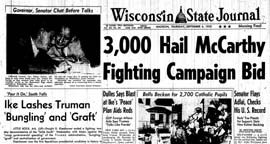
State Journal front page — Sep 4, 1952.
It's like being hit in the face by a friend, blind-sided. I always liked Simon Rosenberg, who presents himself as mild, thoughtful, and above faction. Provoked by Francesca Hong’s near win in the governor’s primary election in Wisconsin, he’s now decided that the Democratic Socialists of America (DSA) are a communist scourge that must be driven out of the Democratic Party. Exaggerated, you say? Check out his Substack. It appears to be starkly out of character and definitely is deeply ironic considering that worry about Joe McCarthy’s native state set him on this path. McCarthy did massive damage to Wisconsin as he did to the entire country and it is not hard to hear an echo of his menacing voice in this development.
Wisconsin has deep reservoirs of left activism. The progressive tradition goes back to the the first constitution in 1848 and early legislation on such topics as married women's property rights and capital punishment (abolished, the first state to do so). In 1854, anti-slavery stalwarts armed with pickaxes broke Joshua Glover out of jail, where he had been remanded by federal agents under the Fugitive Slave Act. The Wisconsin Supreme Court subsequently ruled the Fugitive Slave Act unconstitutional (another first). Our touchstone is Fighting Bob La Follette — governor, senator, presidential candidate. He would have been president too if weren't for the electoral votes of all those other pesky states. La Follette's movement broke through in the 1911 legislature, where together with allies in Eugene Debs' Socialist Party of America they passed a host of ground-breaking legislation like workers’ compensation.
There has always been a strongly pro-worker strain in this state, from John R. Commons to the massive popular resistance to Scott Walker’s anti-labor legislation (the recalls in 2011-2012 were a response to Act 10, which essentially made Wisconsin a right-to-work state for public employees and was meant to eviscerate the unions). AFSCME was founded in Madison in 1932. Milwaukee has a rich history of strikes going back to the nineteenth century, including many sit-down strikes in the 1930s, and the CIO had a strong foothold there. Note to Simon: many actual communists participated in these movements and of course they were driven out of the labor movement between 1947 and 1950, something much to be desired in the case of the supposed communists in the DSA, I guess.

SPA logo ~ 1910.
Socialism has deep roots in Milwaukee going back to German immigrants in the mid-nineteenth century. Eugene Debs credited the indomitable Milwaukee socialist Victor L. Berger with converting him to socialism in 1895 when Debs was in jail over the Pullman strike.[1] Berger joined with Debs and others to create what became the Socialist Party of America (SPA), the main socialist organization in the United States until it was broken up by the US government during the red scare after WWI. The socialists were particularly successful in Milwaukee in the early years of the century, with great influence in the unions and in electoral politics. They pioneered "sewer socialism", embracing such issues as municipal control of utilities for the public interest (Francesca Hong's signature issue is reining in data centers). They sent fourteen members to the 1911 legislature, including two to the senate. They sent Victor Berger to the US House of Representatives three times — the House expelled him twice. Perhaps we should expel AOC from Congress; why stop at the Democratic Party.
Wisconsin was a hotbed of progressivism early in the twentieth century, progressivism broadly understood. Take the Wisconsin Idea, first promulgated by University of Wisconsin-Madison President Charles Van Hise in 1904 — the border of the university is the border of the state. The idea was to extend the beneficent effects of education to all, an ethic persisting to this day. The idea was seized upon by political progressives who energetically promoted political and economic reforms like defanging the trusts and predatory capitalism generally, implementing tax reform (including the first state income tax), direct primary elections, and so much more. These visionaries were bold enough to think that Wisconsin might be a beacon to the nation and it wasn’t all wild talk considering that Social Security was hatched at the UW by economics Professor Edwin E. Witte (Van Hise and Witte have had buildings named after them on the Madison campus).
The anti-war movement of the 1960s and 1970s found fertile soil in Madison, with massive ongoing demonstrations for years, including around the Kent State massacre of May, 1970, when the UW-Madison campus was shut down. Not only Madison and not only students, with the development of deep alliances between students and older generations of activists.

Bernie comes to Wisconsin, 2016.
Bernie Sanders has always been warmly received in Wisconsin. He had no trouble besting Hillary Clinton in the Wisconsin 2016 presidential primary (570,192 to 433,739, 56.6% to 43.1%) and has often returned here. He was a regular at Fighting Bobfest, the annual political revival starting in 2002 that attracted thousands year after year — click the listen button at the top left of this WPR link to get a flavor of the 2005 event, with Russ Feingold railing against the Iraq War and local favorite Mike McCabe demanding a return to the clean politics Wisconsin was known for one hundred years earlier.
The prairie populism that burned so brightly one hundred years ago is alive and well in Wisconsin. Francesca Hong is as Wisconsin as bratwurst and beer. Only an out-of-touch operative ignorant of Wisconsin traditions could fail to realize this fact. Francesca represents the 76th Assembly District stretching from the Capitol to the Barrymore Theater and a little further east, a district where I lived for almost fifty years (her predecessor was Chris Taylor, now sitting on the Wisconsin Supreme Court, having recently won a blowout election). I did not vote for Francesca, thinking she would have a hard time winning a statewide general election, and it looks like I had a lot of company there. Everyone under fifty in my family did vote for her, and she has the respect and affection of all.
Mike Bertrand
Fitchburg, WI
August 17, 2026
^ 1. History of the Social-Democratic Party of Milwaukee, 1897-1910, by Marvin Wachman, The University of Illinois Press (1945). Debs' own story about Berger's role in his conversion to socialism is on p. 15 (and it is quite a story). Debs and Berger and others founded the Social Democratic Party of America in 1897, which changed its name to the Socialist Party of America in 1901. The Milwaukee affilliate retained its old name of Social-Democratic Party of Wisconsin.