
The Tusi Couple
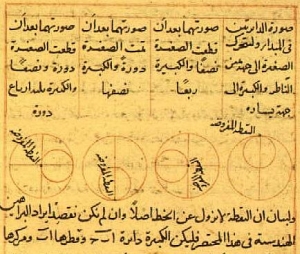
The original Tusi Couple (13th century ms).
The Tusi Couple goes back to the account of Persian astronomer and mathematician Nasir al-Din al-Tusi in the mid thirteenth century (see image here from a contemporary manuscript in the Vatican library, courtesy Wikipedia). It was a mathematical model appearing in a work called Tahrir al-Majisti (Commentary on the Almagest), the Almagest being Ptolemy's canonical second century opus on mathematical astronomy informing all work on this subject in Islamic and European lands through Copernicus and beyond. In the Tusi Couple, a circle one half the diameter of a larger circle moves interior to the larger circle and always tangent to it, rotating with the same angular velocity but in the opposite direction. The remarkable fact is that a given point on the inner circle traces out a straight line segment in the course of its movement. Having moving circles trace out a straight line was a big deal in the circle-centered Ptolemaic tradition.
All these animations were generated by Gemini. Click the pause icon at the bottom left to pause, then restart when desired by clicking the start icon. F. Jamil Ragep translated the old manuscript into English in 1993 in two volumes under the title Naṣīr al-Dīn al-Ṭūsī's Memoir on Astronomy, with English and matching Arabic on opposite pages. Here is the relevant passage:
If two coplanar circles, the diameter of one of which is equal to half the diameter of the other, are taken to be internally tangent at a point, and if a point is taken on the smaller circle—and let it be at the point of tangency—and if the two circles move with simple motions in opposite direction in such a way that the motion of the smaller [circle] is twice that of the larger so the smaller completes two rotations for each rotation of the larger, then that point will be seen to move on the diameter of the larger circle that initially passes through the point of tangency, oscillating between the endpoints.[1]
The animation above produces the Tusi effect, with both circles rotating at the same angular velocity in different directions, a little over four seconds per revolution on my computer. Perhaps by "the motion of the smaller [circle] is twice that of the larger", the sage meant the relative rotations of the two circles. But the first animation definitely does not show that "the smaller completes two rotations for each rotation of the larger" — rather, they both rotate at the same angular velocity, each circle completing one revolution in the same amount of time. To see this, visually track the green tick mark on the outer circle, which completes one revolution as the horizontal line completes one back-and-forth oscillation and the inner circle also completes one revolution (follow the red arrow). This must be right, because doubling the angular velocity of the inner circle produces a trefoil inside the outer circle, as shown in this second animation. Pretty, but not a straight line segment!
Proceed as follows to prove that the Tusi couple produces a straight line as the two circles rotate. Referring to the first animation, assume that the center of the outer circle is the origin \((0,0)\) and let the outer circle be the unit circle. Suppose that the circles' angular velocities are \(\omega\) and \(-\omega\) and that \(t\) represents time. Then the position of the center of the inner circle at time \(t\) (the blue vector) is \(\tfrac{1}{2}e^{-i\omega t}\) and the red vector is \(\tfrac{1}{2}e^{i\omega t}\). If \(V_b\) is the blue vector and \(V_r\) is the red vector at time \(t\), then:
\begin{align*}
V_b + V_r &= \tfrac{1}{2}e^{-i\omega t} + \tfrac{1}{2}e^{i\omega t}\\[0.5em]
&= \tfrac{1}{2}(\cos{(-\omega t)} + i \sin{(-\omega t)}) + \tfrac{1}{2}(\cos{(\omega t)} + i \sin{(\omega t)})\\[0.5em]
&= \tfrac{1}{2}(\cos{(\omega t)} - i \sin{(\omega t)}) + \tfrac{1}{2}(\cos{(\omega t)} + i \sin{(\omega t)})\\[0.5em]
&= \cos{(\omega t)} + 0 \cdot i
\end{align*}
This shows that the sum of the vectors moves back and forth along the horizontal diameter of the outer circle and indeed that the motion along the line is sinusoidal.
Copernicus and the Tusi Couple
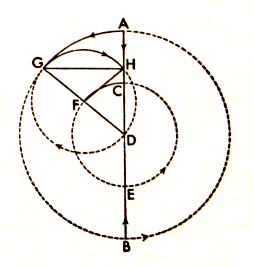
Tusi Couple in De revolutionibus
Amazingly, Copernicus included the Tusi Couple in De revolutionibus in 1543. He did not cite Tusi and the chain of transmission, if any, is uncertain. Perhaps Copernicus reached for the same tool when addressing the same problem. All the same, scholars are intrigued and have pointed to Italy as a possible venue for the transmission of these ideas, considering Copernicus's extended stay there as a young man and the systematic discussion of the Tusi diagram in Giovan Battista Amico's De motibus corporum coelestium, published in Venice in 1537, long after Copernicus's stay in Italy but before the publication of De revolutionibus.[2]
To understand this diagram of Copernicus, note first that the outer circle is rotating counter-clockwise as suggested by the little arrows to the left of point \(A\) and the right of point \(B\). The diagram captures the moment when the point that started at \(A\) has rotated to \(G\). That is, the point on the outer circle starting at \(A\) has moved counter-clockwise along the arc \(\overset{\frown}{AG}\). The inner circle concentric with the outer one also rotates counter-clockwise at the same angular velocity. The smaller circle centered at \(F\) has rotated clockwise at the same angular velocity so that the point on that circle that was originally at the the top of the diagram (where fixed point \(A\) is located) has rotated to \(H\). The goal is to show that point \(H\) is on the vertical diameter \(AB\). But this is obvious, since \(FD\) and \(FH\) are equal, being radii of the same circle, implying that \(\triangle DFH\) is isosceles, so \(\angle FHD = \angle FDH\).
de La Hire
Another variable to adjust in the Tusi arrangement is the length of the red vector. That is, retain the idea of the two circles, one half the diameter of the other and rotating inside the outer circle and tangent to it and rotating at the same angular velocity but in the opposite direction. But now trace out a figure determined by a red vector as before, but shorter or longer than the radius of the inner circle. The figure traced out is an ellipse, as shown in the animation here. The setup is logically equivalent to having both vectors at the center of the outer circle and rotating at the same angular velocity and in different directions, the figure traced out being the vector sum. The circles can be dispensed with. That is exactly the scenario discussed in this article, which includes the proof that the locus is an ellipse. The two phenomena exemplified by the first animation (straight line locus) and this one (elliptical locus) are known as La Hire's Theorem — the link goes to French Wiki and translate to English in the browser if your French is as weak as mine.
Philippe de La Hire was an accomplished mathematician who wrote on conic sections and related geometrical topics — his mathematical output was typically abstract, but often motivated by practical mechanical engineering considerations like gears. Read the St. Andrews account to get a picture of the broad interests and varied career of this early follower of Descartes and Desargues: painter, geometer, engineer, astronomer, architect, cartographer. He has been unfairly overlooked. According to Carl Boyer, after Desargues, Pascal, and Fermat died in the early 1660s:
About the only mathematician of stature in France at the time was Philippe de La Hire, a disciple of Desargues and, like his master, an architect. Pure geometry obviously appealed to him, and his first work on conics in 1673 was synthetic, but he did not break with the analytic wave of the future.[3]
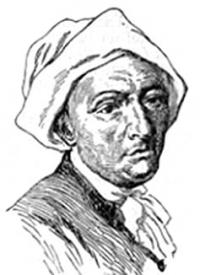
Philippe de La Hire
(1640-1719)
(1640-1719)
de La Hire proved his theorem in a very general context in 1706 in Traité des roulettes (Treatise on Roulettes), the term "roulette" meaning a curve generated by a point attached to a rolling curve, including epicycloids, hypocycloids, and the like, as we would call them today. He is reputed to have rejected infinitesimals, but applies them pretty freely in the Traité.
Discussion of the deep history of this problem could continue, the names Cardan (1501-1576) and Proclus (412-485) being brought in[4], but enough. One ongoing lesson is the connection of pure mathematics to more practical matters like astronomy and gearing, reinforcing the pragmatic origins of so much mathematics.
Mike Bertrand
August 9, 2026
^ 1. This quote is from the Wikipedia article on the Tusi couple, which in turn cites Naṣīr al-Dīn al-Ṭūsī's Memoir on Astronomy, Volume 2, by F. J. Ragep, ISBN 0-387-94051-0, Springer (1993), pp. 94, 196. These two volumes of Ragep include a translation of Tusi's thirteenth century work, plus historical and scientific commentary.
^ 2. "Copernicus, Amico, Fracastoro and Ṭūsī's Device: Observations on the Use and Transmission of a Model" by Mario di Bono, Journal for the History of Astronomy, Volume 26 (1995), pp. 133–154.
^ 3. A History of Mathematics, by Carl B. Boyer, ISBN 0-471-09374-X, John Wiley & Sons (1968), p. 404.
^ 4. "Copernicus and Nasīr al-Dīn al-Tūsī", by I. N. Veselovsky, Journal for the History of Astronomy, Volume 4 (1973), pp. 128–130.